Serving USA & Canada | 978‑486‑3116 | Current pricing valid through October 1, 2024 due to ongoing tariff and vendor rate changes. Order now to lock in current rates before the next update.

Call our team at Louis Page: 978-486-3116 | Free Quote

The Fence Post

A Flat Twist on fencing in my own garden

May 5, 2025 | by Duncan Page

unnamed (10)A Flat Twist on Fencing in My Own Garden

Today, I want to share a unique approach to fencing my garden—a “flat twist,” you could say—inspired by an intriguing idea I stumbled upon online. While my initial attempt was met with great success, a recent challenge has prompted me to seek your insights and experiences.


The Challenge of Wildlife in New Hampshire

In the beautiful, wildlife-rich landscape of New Hampshire, where we contend with black bears, porcupines, deer, groundhogs, voles, chipmunks, and squirrels, protecting the bounty of my berries and tomatoes has always been a priority. Instead of opting for the conventional approach, I decided to explore an unconventional method to deter these marauders.


The Unconventional Solution

You might be wondering why I didn't resort to the usual fencing methods as the owner of a fencing company. The answer lies in the urgency of the situation. When I moved to my new home, I couldn't find anyone available to install a fence in time for the gardening season. So, in my quest to safeguard my garden, I discovered a fascinating concept online: laying wire mesh fencing directly on the ground to create a unique and barrier-free solution.

Initially, the results were nothing short of spectacular. The wire mesh effectively deterred wildlife and safeguarded my cherished plants for two years, leaving fellow gardeners impressed. The ingenious idea seemed to work like magic—no posts, no gates, just a simple wire mesh laid on the ground.


The Theory Behind the Method

The core theory behind this method was that the animals disliked walking on the wire mesh and stayed on the other side of it—out of my garden. It was indeed a clever and low-maintenance idea, which is what initially drew me to it.


Facing New Challenges

However, as time passed, a new challenge emerged. Grass and weeds grew through the mesh, gradually compromising the once-secure barrier. This growth partially covered the wire and made it easier for the very animals I sought to keep out to access my garden once more.


Seeking Your Insights

I'm reaching out to you, our valued customers, because I believe in the power of shared experiences and collective wisdom. Have you ever experimented with a similar approach in gardening or farming? Did you face any challenges similar to those I'm currently grappling with? If so, I'd greatly appreciate hearing about your experiences and any innovative solutions or recommendations you may have.

Specifically, I'm interested in learning how you managed to maintain the integrity of the wire mesh fence over time, particularly in the face of grass and weed growth. Your firsthand knowledge will help me address this issue and continue to protect my garden successfully.


Join the Conversation

Please reply to this email or contact me directly at your convenience. Your insights and experiences matter greatly, and I am eager to engage in a fruitful exchange of ideas.

Thank you in advance for your time, expertise, and support. I look forward to hearing from you soon and continuing to grow and learn together as a community of passionate gardeners.

Of course, I did get the mesh I laid on the ground from Louis Page 😉️

Warmest Regards,

Debbie Page

CEO, Louis E. Page Inc – Woman-owned business and Family-owned since 1893. (Unquestionably it’s been 130 years owned and run by our family)


Read More

Topics: deer fence, galvanized, fixed knot, deer and wildlife fence

Tips for Using Hardware Cloth - Video

May 13, 2021 | by Joe Morrell

Some Very Handy Tips

Wait for it! Some excellent hands-on help with managing hardware cloth.


Hardware Cloth is great for a variety of different applications, including:

  • aviaries
  • window guards
  • screen door reinforcement
  • exclusion screens for nuisance wildlife
  • small animal cages
  • shrub and tree protection
  • sieves and strainers
  • stucco mesh
  • ferro-cement boats
  • sculptures and other structures

16 gauge hardware cloth chicken coop 3

These wire cloth meshes are not just available with galvanized-after finishes--hardware cloth is also available with vinyl-coated and stainless steel finishes. 

Hardware Cloth

Read More

Topics: hardware cloth, galvanized

Fencing-in Goats - Video

April 16, 2021 | by Joe Morrell

Pasturing Goats - A Basic Design

Here's a practical demonstration in creating a very sound enclosure for keeping goats: 


Learn more about Goats and Fencing.

 Sheep and Goat Fence

Read More

Topics: woven wire, high tensile wire, galvanized

Rebuilding an Agricultural Fence

November 23, 2020 | by Joe Morrell

The Right Tools 

The wonderful folks from Bekaert step in to help renew an extensive field fence with high tensile woven wire and barbed wire. A classic demonstration using a gripple, a stretcher bar, and a new-fangled staple gun.

Farm and Field Fence

Read More

Topics: woven wire, galvanized, how to

Why You Need a Black Vinyl-Coated Deer Fence

September 22, 2020 | by Joe Morrell

2018Deerfence

Stopping Deer

Avoiding damage to your property from deer is best accomplished with a sturdy, well-maintained fence. There are some unique solutions to repelling deer using fencing and we begin with the fact that black is very difficult for deer to see. A deer will not risk jumping over a fence that uses black Bezinal-coated zinc-aluminum finish on the wire; it makes it very hard for them to discern the boundaries of the fence. In a single bound, deer can clear about 8 feet. The height and diameter of the black-coated wire of a 7-foot fence will cause enough confusion to send them rummaging for food elsewhere. A deer's capacity for flight is prodigious, and gauging risk to its limbs is an innate skill. An injury to a leg means becoming fodder to predators. For your part, the preparation and maintenance of a deer fence must include various factors:

  • Make sure that the fence is tight to the ground to prevent the deer from crawling under the fence
  • Vines that will inevitably grow on it should be cleared--the vines will eventually add definition to the fence which will aid the deer in clearing it 
  • Keeping the fence in good repair is key as deer are quick to find where the fence has been damaged
  • Gates mean access and must be kept closed especially before dusk

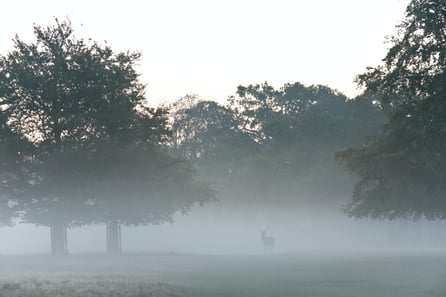
deer in misty field with trees

Twilight and Superior Night Vision

  • Comparing the eyes and pupils of deer to humans, a deer's are larger on both counts
  • The light-gathering capacity works out to be about nine times that of human vision
  • The receptors of light in the back of a deer's eye (rods and cones) are accompanied by a reflective layer which to us appear to shine at night
  • These receptors, the rods, cones, and the light which interact to create a deer's ability to have superior night vision means that it is at final count 18 times better than human eyesight at night (for our part, the capacity for detail during the day is superior to a deer's)  

Hence, a deer's most effective vision comes in low light. So, as our vision towards evening starts to dim, a deer's vision is just getting going. The shape of a deer's eye is more oval, maximizing objects on the horizon where danger may lurk, rather than from above (here's a reason why hunters that are elevated above the deer's primary source of reference have an advantage.) For a deer, the light from above can distract and this is why the black 7-foot fence is enough for them to avoid the risk of not clearing it--what's above them is simply not a usual source of threat from predators. 

The Mesh You Need

You'll find that black vinyl-coated hexagonal deer fence lasts a long, long time. The 20-gauge galvanized wire is woven into a 1" hex mesh, galvanized, and then coated with a tough, flexible, thick coating of black PVC tightly bonded to the wire. The resulting vinyl-coated deer fence is very corrosion resistant. It is also extremely resistant to cracking, chipping, and weathering and the inhibitors in the vinyl protect it from UV degradation. Another benefit of the black coating is how it makes the mesh blend in with the landscape. Call Louis Page (866) 328-5018 if you have more questions. 

Although the initial outlay may seem expensive, the most cost-effective plan to guard your outdoor investments is a deer fence and when considered over time, it becomes very cost-effective. 

Shop Deer Fence

Read More

Topics: high tensile wire, deer fence, galvanized, deer and wildlife fence

Request Your Quote Now. Get Fast Quotes.
Click here to shop our online store

Recent Posts

Subscribe to Email Updates