
Keeping it simple! Instructions for installing a farm gate.
Keeping it simple! Instructions for installing a farm gate.
On the Land or on the Sea
New types of security fencing are currently being developed and evaluated. One type is called "floating" fence. There are two different "floating" fences - one for use on land and the other one on water.
Floating Fence Used on Land
A 15-foot high fence stretches along a seven-mile section of the US-Mexico border in the Imperial County sand dunes between Calexico, California and Yuma, Arizona. This particular area is subject to drifting sand which causes changes in the topography.
Built at a cost of $40 million, the unique floating fencing is designed to be unfastened to anything below the sand's surface. When drifting sand starts to bury the fence line, sections can be lifted up by a machine and placed back on top of the sand allowing the 15-foot height to be maintained. New fencing does not have to be erected. Known as the "floating fortress" and "sand dragon", this new fence design is credited with reducing not only illegal immigrants but also drug smuggling.
See a picture of the floating fence.
Floating Fence Used on Water
The other type of "floating" fence is being used by the US Navy as a way of protecting ships from terrorist attacks. Termed a "Waterfront Force Protection Barrier System", over 30 kilometers of floating fences have been successfully installed around Navy installations.
The floating fence, capable of stopping high-speed boats, is adapted from a fixed security barrier system. The fencing consists of independent 35 to 50-foot modules that are connected to each other. Pontoons support a steel structure. Vertical steel nets, usually 9 feet tall, are secured to this structure and sit on cylindrically shaped floats that form the actual fence. Variations in currents and tidal ranges up to 30 feet are accommodated. Gates are incorporated into the design as required.
Read the PDF about floating fences from Harbor Offshore Barriers, Inc.
Can you think of other situations where either of these fences could be of use? Do you think they're cost-effective?
Topics: fence, floating fence
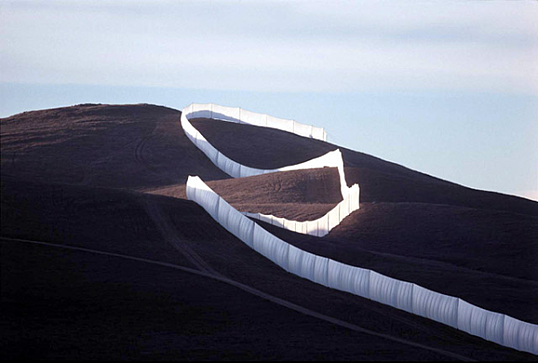
Running Fence
Christo and Jeanne-Claude
A Passing Horizon
In April of 1976, after four years of planning and obtaining required permits and permission, construction began on an unusual fence. Completed on September 10, Christo and Jeanne-Claude's "Running Fence" was removed, leaving no traces, fourteen days later on September 23rd.
The 18 foot high fence was made with 2,222,222 square feet of heavy woven white nylon fabric. It wound for 24-1/2 miles through the rolling hills of Sonoma and Marin counties in northern California, terminating in the Pacific Ocean in Bodega Bay. The Running Fence crossed 14 roads and the town of Valley Ford. Openings were left for cars, people, cattle and wildlife. It was placed so that it could be viewed from 40 miles of public roads, as shown in this old super 8 movie.
Creating the Fence, Dismantling the Fence
350,000 hooks were used to attach the top and bottom edges of the heavy fabric to steel cables. The cables were secured to 2,050 - 3-1/2" x 21' tubular steel posts set 36" in the ground. Posts were not set in concrete. 90 miles of cable and 14,000 earth anchors were used to laterally brace the posts. Close to 400 people helped install the fence. After its removal, all material was given to the ranchers who had allowed it to pass through their property.
In addition to the materials used, all paid for by Christo and Jeanne-Claude, this monumental art project consisted of:
- 18 public hearings
- participation of local ranchers
- 42 months of collaborative efforts
- drafting a 450 page Environmental impact Report
- three sessions of the Superior Courts of California
- temporary use of hills, the Pacific Ocean and the sky
The project elicited strong reactions.
Do you think this is a work of art?
Topics: fence
The Aesthetic Edge
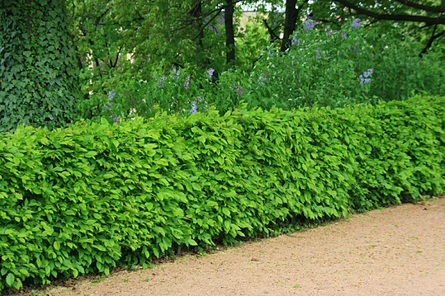
Living fencing can be an alternative to conventional wire, wood, vinyl and masonry fences. As noted in David Beaulieu's excellent article "Living Walls as Privacy Fences", living fencing has certain advantages:
- lower cost
- more attractive
- fruit production
- reduces traffic noise
- seasonal foliage variation
- provides a habitat for birds and small animals
- sometimes less restricted by zoning regulations
- can be pruned and sculpted into different shapes
Simplicity, Beauty, Style
Living fences make excellent privacy screens around your property. Planting a thicket of small trees or shrubs creates an effective barrier. Flowering bushes, deciduous and evergreen shrubs can be planted. The type of plants used will determine the height, width and appearance of the fence. How they are planted will determine the visual and physical tightness of the barrier. If necessary, a conventional fence can also be used to keep pets and children in the yard. A living fence can also be used around smaller areas in the yard such as patios.
An Efficient Windbreak
Living snow fences can also be a great alternative to plastic or wood snow fencing. The design will determine downwind snow distribution. A dense multiple row living snow fence will pile snow in a restricted area, reducing the need to plow highways and driveways. To make windbreak for the uniform distribution of snow across a field, a single row of tall deciduous trees can be spaced 15 to 20 feet apart. Snow will be distributed to a distance of 10 to 15 times the height of the trees.
Creating a Beautiful Hedge
A good hedge doesn't stop the wind but breaks up as it rushes across the land, sparing plants needing protection. A solid fence can sometimes create a pocket of air as it surmounts the top of the fence whereas a hedge distributes the flow of wind. Happily, the hedge creates a habitat for birds and enhances the environment. Be careful in your choice of plants for a hedge. For privacy and a consistent wind block, look for a hedge that doesn't drop its leaves in winter. Some research is required.
Here's a video about a boxwood hedge that may be of interest:
Learn more about living snow fences.
Have you ever considered planting a living fence? Would living snow fencing be a solution that would work for you?
Topics: fence, snow fence, living fence
A nuisance in the fields, gardens, highways...
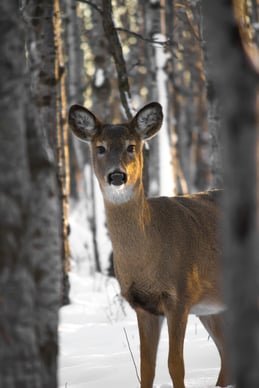
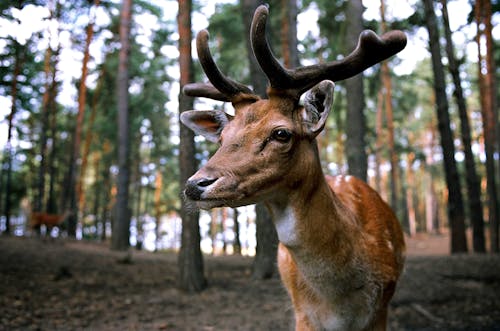
It is common knowledge that deer have become a problem which seems to intensify every year. Deer have been forced into closer contact with humans as their natural habitat has decreased. Also, the numbers of their main predators, wolves and cougars, have dwindled over the years. Hence, their population is on the rebound. As a result, deer have become not only a nuisance but also, in some situations, a threat to human life.
- Hungry deer invade gardens and areas with expensive plantings.
- The impact on agriculture - farms and orchards - is extensive and expensive.
- The USDA estimates that total deer damage from auto collisions and crop and timber losses
reaches at least $1 billion a year- Deer on the roads cause many accidents, often fatal to both deer and people.
- There are 1.5 million car accidents with deer each year, resulting in human fatalities, and personal injuries.
- When deer are present there is an increased risk to humans of Lyme disease spread by ticks.
- Deer overpopulation reduces the quality of habitat. The resulting lack of food can lead to unhealthy diseased deer.
The population increases have been in both urban and suburban areas. Forested areas have suffered, too. The over-browsing of the undergrowth of trees robs birds of habitat and disrupts new growth of trees: disrupting seedlings, buds, while the rubbing of antlers on trees can destroy them completely.
It's not always straightforward. A few possible means of control are:
Exclusion
Deterrents
- Deer and wildlife fence barriers
- Individual trees and plants protection
- Plants deer dislike
Population management
- Devices to scare deer with sound or visual stimuli
- Dogs
- Repellents using odors deer dislike
- Hunting
- Culling - thinning out weak unhealthy animals
- Fertility control
What do you think is the best solution for your particular deer problem?
Is there one solution that can address every situation? Is inaction the better strategy?
Topics: deer fence, exclusion fence




1 Main St Whitinsville, MA 01588 (Limited pickup in Whitinsville)
978-486-3116
8:30 to 4:30 (EST) Mon through Fri