Subscribe to our blog by email

Your email:

751c83d4-7a6b-403b-aa68-35954385dbbb

3e2d4fe2-c242-4a26-b2ae-db208b977fa6

fa1bf891-9609-4085-9bce-65909dc5208f

facebook twitter flickr


Better Busibess Bureau

Add to Technorati Favorites

Our Blog - "The Fence Post"

Current Articles | RSS Feed RSS Feed

Vinyl Coated Welded Wire Mesh vs. Skunk - Which Will Win?


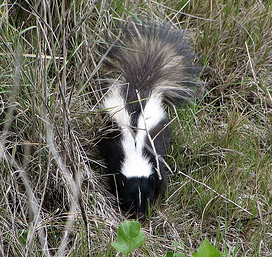
skunk stopped by wire mesh

The Skunk Under My Shed Is A Terror!

I have to think twice before taking the garbage out at night or going to find something in the shed after dark. When I go from car to house or house to car after dark, I move quickly with eyes scanning the ground for a fluffy shadow or set of eyes twinkling in the moonlight. My dwelling is terrorized by a skunk that wages a putrid form of guerrilla warfare against my household. It has made its home under our shed and I am loath to engage it in battle. It has to go, because we can’t stand the thought of more summer evenings spoiled by the threat of an altercation with the hostiles. The question is, how do you get rid of a skunk?

Modern life offers a lot of very easy solutions to problems that were confounding to earlier generations. Unfortunately, there is no “easy button” for skunk removal. Unless I am willing to damage the shed (what I’m calling the tip and run method), the animal (poison), or both (flooding/burning) I don’t know how to avoid the physical act of removing the animal. There are some tips on how to get rid of them, but the ones that don’t risk an encounter with the skunk, seem not to work. For example, I read that putting a dirty sock by their entrance would make them move their home. This is untrue. I put a post-basketball sock out there and if this sock wasn’t dirty enough, we might be better off with the skunks than a dirtier sock. I waited a few days hoping that the skunk's repeated encounters with the sock would send it packing, but no. The skunk remains.

As may already be apparent from this post, I have an intense fear of being sprayed by a skunk. Generally I like do-it-yourself projects, but I think for the removal phase of this project I will have to turn to a professional. I spoke to a Louis Page customer, Erik from Needham/Woburn Pest Control, about how to keep the critters out from under the shed once they are extracted. He recommended the following labor intense, but straightforward solution.         

  1. Dig a trench around the shed that should be 12” deep and 12”-18” wide extending away from base of the shed.
  2. Using ½" x ½" welded wire mesh, 36” wide, staple the top edge to the base of the shed with galvanized staples.
  3. Lay the remaining 30 or so inches into the trench to cover 12” inches down and 18” out.
  4. Backfill the trench and voilà! Skunk proof!

Since the mesh will be underground, I’ll need to be sure that it is resistant to rust and corrosion. Galvanized after weld offers good protection, but something black vinyl coated would be even better and the small amount of exposed wire mesh around the base of the shed will look much better over time if it does not rust. Also the black color will be virtually invisible. This is really not something I want to do twice.

That’s the plan I think. I’ll post a follow up to let you know how it goes.

Josh Lane signature    Josh Lane


Comments

Most wildlife can be kept out of structures with 1 x 1, 1 x 1/2 or 1/2 x 1/2 wire. A better question instead of size is what wire gauge to use. While 28 ga wire will keep out chipmunks a woodchuck may rip it open allowing access. On the other hand, 14 ga wire will keep out woodchucks but it is very expensive and may not be as easy to work with leaving openings the animals can exploit.  
 
In my opinion, for wildlife exclusions use 14 ga with 1 x 1 wire, 16 ga with 1 x 1/2 wire and 19 ga with 1/2 x 1/2 wire will give the maximum results for the minimal cost. Also, barriers are not so dependant on depth as to length (ideally the animal is on top of the wire when it starts to dig) so there is no need to dig a foot down. Rather, you want the animal to encounter the wire quickly and stop digging so 6 or 8 inches down with 16 - 18 inches out will give plenty of protection in most cases.  
 
The general rules for animal barriers are use PVC for protection when burying or submerging wire, use 1 x 1 or 1 x 1/2 for larger animals (raccoon, woodchuck, etc.) and 1/2 x 1/2 (chipmunks, snakes, etc.) for smaller animals, use wire that is at least 24" wide (this will depend on how much area needs protected above ground level with 6" down and 18" out), peg the wire down if necessary then cover it, make sure to exclude all sides of the building, and don't be afraid to use extra wire on the corners or around wires or landscaping. 
Posted @ Wednesday, March 06, 2013 2:52 PM by Eric Arnold
Thanks for the information Eric. That makes sense what you say about wanting the animal to find the wire quickly and stop digging. Fortunately I don't have woodchucks so I think the 14 gauge wire is out of the question. I appreciate your comment. Thanks.
Posted @ Wednesday, March 06, 2013 3:28 PM by Josh Lane
Great post! And thanks to Eric for your advice. 
 
Debbie
Posted @ Wednesday, March 06, 2013 3:33 PM by Duncan Page
You still need to get rid of the skunk who has already taken up residence under your shed. Have you tried predator urine? You can buy it in hardware stores and online. I used coyote urine to scare away a family of raccoons who had decided to move into our attic.  
 
If that doesn't work, you could always bait a trap nearby and catch the skunk in it. It would likely spray, but at least you would be able to get rid of it once and for all. 
 
It isn't necessary to bury a wire apron around the shed in order to prevent critters from digging underneath. An apron laid flat on the ground works just as well. You can cover it up with mulch, or if there's grass there, the grass grows right up through the mesh, hiding and anchoring it. This is the method I use to protect our chickens from predators trying to dig into their pens. 
 
I use the vinyl coated wire for all our outdoor bird enclosures because it looks so much better than plain galvanized wire. And after four years, it still looks good as new.
Posted @ Wednesday, March 06, 2013 4:01 PM by Lori
Post Comment
Name
 *
Email
 *
Website (optional)
Comment
 *

Allowed tags: <a> link, <b> bold, <i> italics