Subscribe to our blog by email

Your email:

free catalog button

contact  us button

quick quote button

flickr

field fence on Kaua'i

facebook


Add to Technorati Favorites

Browse By Tag

better business bureau

Our Blog - "The Fence Post"

Current Articles | RSS Feed RSS Feed

What Kind Of Wire Fence Will Keep Your Pet Safe?

Share on Twitter Twitter | Share on Facebook Facebook | Submit to Digg digg it |  Add to delicious  delicious |  Submit to StumbleUpon StumbleUpon |  Share on LinkedIn LinkedIn | Submit to Reddit reddit 

coyote

As more undeveloped land is taken for house lots and commercial areas, the natural habitat for wildlife is increasingly restricted. Sightings of animals such as coyote and deer are more frequent. The need for a way of protecting pets from potentially aggressive wildlife increases.

One of the best ways to keep pets safe is to build a wire fence. To protect against coyotes it is best to use a six foot height. You can either bury 12 inches in the ground or bend it so it lays on top of the ground to the outside of the enclosure as an apron. This will discourage digging.

There are many choices of welded wire fencing and woven wire fencing meshes available:

Welded wire fencing - Galvanized Before Weld (GBW), Galvanized After Weld (GAW) and Vinyl Coated (VC) 

  • 14 gauge, 1"x2" and 2"x4" mesh
  • 12.5 gauge, 2"x4" mesh
Woven wire fencing
Any of the fences listed above can make your yard safe for your pet. Follow the links for a more detailed description of their features.

There is an informative blog article in The San Fransisco Examiner: "Tails From The City". It has some additional non-fence advice for protecting pets from coyotes.


How To Build A Garden Fence & Arbor - Video

Share on Twitter Twitter | Share on Facebook Facebook | Submit to Digg digg it |  Add to delicious  delicious |  Submit to StumbleUpon StumbleUpon |  Share on LinkedIn LinkedIn | Submit to Reddit reddit 

This video will show you how you can build an attractive wood garden fence and arbor in your yard.


Tags: 

Do You Need Wire Mesh With Small Openings?

Share on Twitter Twitter | Share on Facebook Facebook | Submit to Digg digg it |  Add to delicious  delicious |  Submit to StumbleUpon StumbleUpon |  Share on LinkedIn LinkedIn | Submit to Reddit reddit 

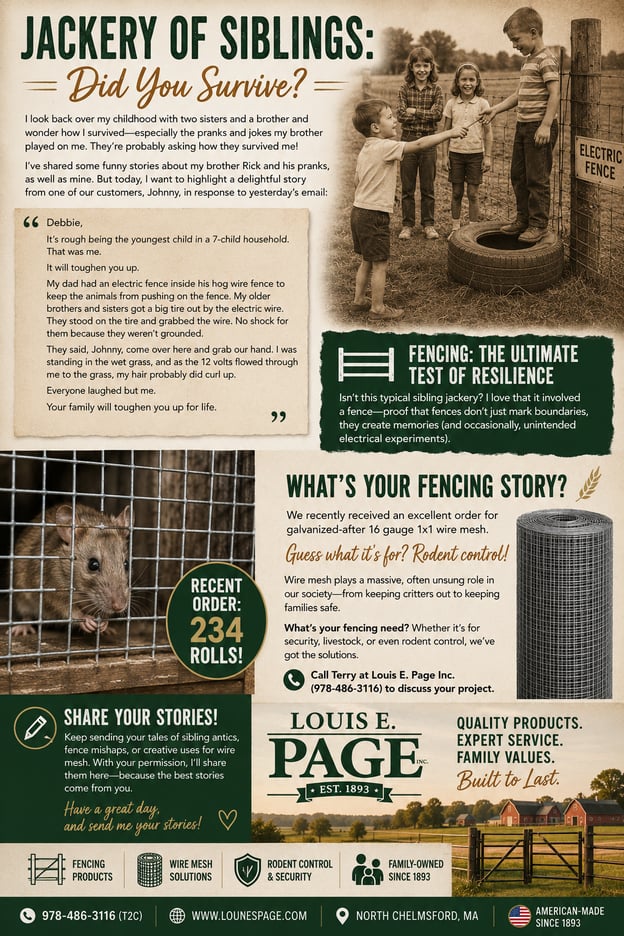
There are many different sizes of wire meshes that are available 1/2with small openings. Most often called hardware cloth, these meshes are usually welded using light gauge wire. After fabrication, the finished product is hot dipped in zinc. This Galvanized After process not only provides good protection against rust and corrosion, but also stiffens the welded fabric.

Until recently, Galvanized After woven meshes were as easy to obtain as the welded products. Woven mesh is not always exactly square due to the weaving process which can cause slight distortions resulting in a "wavy" mesh. Depending on the final application, woven products are often preferred over the welded meshes. They tend to be a bit heavier and stronger. They are also more costly.

As the small opening wire mesh size gets smaller, so does the gauge or thickness of the wires. The more common sizes and wire gauges of square meshes are:

  • 1/2" - also known as 2x2 and 2 mesh (2 squares per inch) 19 gauge wire
  • 3/8" - also known as 3x3 and 3 mesh (3 squares per inch) 21 gauge wire
  • 1/4" - also known as 4x4 and 4 mesh (4 squares per inch) 23 gauge wire
  • 1/8" - also known as 8x8 and 8 mesh (8 squares per inch) 27 gauge wire

There are many other Galvanized After mesh 1/4sizes and gauges available as well. These are often called industrial wire cloth. They are woven, heavier, more expensive, and often must be special ordered. The more common sizes are:

  • 5/8" - 17 gauge wire
  • 3/4" - 16 gauge wire

In addition to galvanized products, the 1/2", 19 gauge and 1/4", 23 gauge mesh styles are available with a black PVC coating over the Galvanized After core wire.

These excellent and long lasting meshes can meet the requirements of many different projects.


All Posts